Year: 2017

  • An Ode to Gulls

    Before I arrived on Great Duck Island, a few people asked me “why on earth would you want to study sea gulls? There are so many of them. They’re like rats.”

    I usually answered with a version of “…it is important to study every aspect of an ecological community. Gulls influence many other species…” But such a vague, abstract answer always fell on deaf ears.

    People’s distaste for gulls had me thinking: how can ordinary people begin care about gulls; how can people come to feel the same love for this bird that comes naturally to field researchers who witness the majesty, grace, and care these bird exhibit daily?

    juvenile black-backed gull
    A juvenile greater black-backed gull.

    After much thought, the answer came to me in three parts.

    1. Poems.

    2. Pictures.

    3. Realizing that gulls are more human than you might think.

    An Ode to Gulls

    Flying Rats

    Why do psychologists study people?

    There are so many.

    They are like rats.


    Why do we study gulls?

    They are so varied.

    They are like people.

    Immature gull.

    Eyes Bigger than Your Stomach

    My grandmother has a saying,

    “Your eyes were bigger than your stomach.”

    It is reserved for the occasion

    When you couldn’t finish all

    Of a hefting meal where you took too much meatloaf.


    I’ve seen herring gull chicks

    With eyes bigger than themselves.

    Trying to swallow whole fish:

    Head, tail, bones, scales,

    A hefting meal larger than the weeks-old ball of down.

    herring gull chick
    A young herring gull chick sitting on its haunches (probably after a large meal).
    Migration

    Some people live

    In the same town their entire life.


    Other people can’t stay in the same town

    For more than a few years.


    Some gulls live

    In the same state, from winter to summer.

    Frequenting local sand bars,

    Exploring the inland scene,

    And always flying back to the island to nest each summer.


    Other gulls live

    In many states, from winter to summer.

    Frequent fliers visiting distant shores,

    Exploring more tropical lands and seas,

    And always flying back to the island to nest each summer.

    Sparing herring gull.
    A herring gull soars over the colony.
    Parentage

    Like a human child,

    Young gulls mature in stages.


    Baby chicks stay near the nest,

    Adolescent chicks wander,

    Teenage chicks explore—

    Until the island’s berms give way to a boundless world,

    As their young wings form their first flights.


    But like a human child,

    Young gulls always know where to beg for food.

    Adult and chick
    A herring gull parent with its chick.
    Carl the Gull

    Villages band together,

    For safety.


    Gulls nest together,

    For safety.

    When a predator nears the colony,

    You hear it before you see it.

    But you don’t hear the eagle,

    You hear the sound of hundreds of birds,

    That always have each others’ backs.

    Gulls chasing eagle.
    Herring gulls chasing a bald eagle away from the colony.
    Larus Lessons

    People can learn from gulls.

    Learn to see themselves in others,

    Learn to appreciate beauty in the usual,

    Learn to stand up for themselves and each other.

    herring gull bellowing
    This herring gull bellows a warning.
    More than Gulls

    I was lucky to study gulls on Great Duck Island, but that’s not all I did.

    Learn more about the island’s history, see how the landscape changed over the summer, and find photos of songbirds, puffins, and wildflowers from the island off the coast.
  • Time-Lapse Video of Great Duck Island

    I studied songbirds and seabirds as a field researcher on Great Duck Island. But I also documented the island landscape.

    In a series of time-lapse videos, each captured by taking hundreds of photos over the course of a few hours, the remote Maine island shines. 

    Watch the high definition video below or on Youtube.

    See more of my photographs from Great Duck Island, from puffins to plants, by following this link. 

  • The Summer Visitors of Great Duck Island

    A Summer Sojourn

    On Great Duck Island, the field researchers from College of the Atlantic are temporary summer visitors. But they are not the only ones. Almost all of the birds who rely on the small protected island in the Gulf of Maine for breeding, nesting, and raising young are only summer visitors themselves.

    June 2017. The end of my second year at College of the Atlantic in Bar Harbor, Maine. After I wrote my human ecology essay and finished spring term, I hopped on the M/V Osprey to Great Duck Island—a haven for nesting seabirds. The island is about 10 miles southeast of Mount Desert Island, Maine, where College of the Atlantic and Acadia National Park are located.

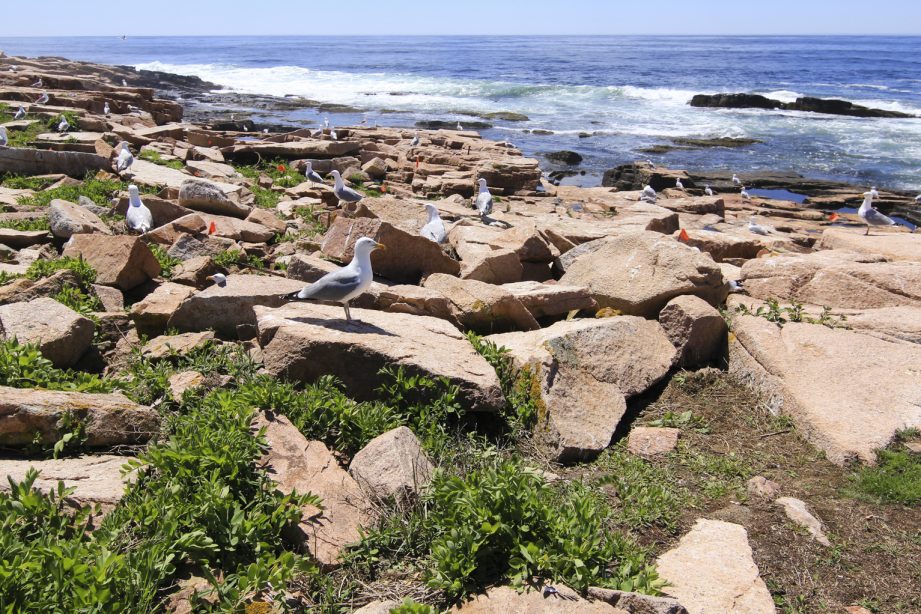
    Many herring gulls nest in the crevices between boulders on the rocky berm of Great Duck Island, their nests marked with orange flags by College of the Atlantic researchers.

    The professor of ecology at College of the Atlantic, John Anderson, manages the college’s Alice Eno Research Field Station on Great Duck Island. The 1890 Coast Guard light keeper’s residence houses the research station.

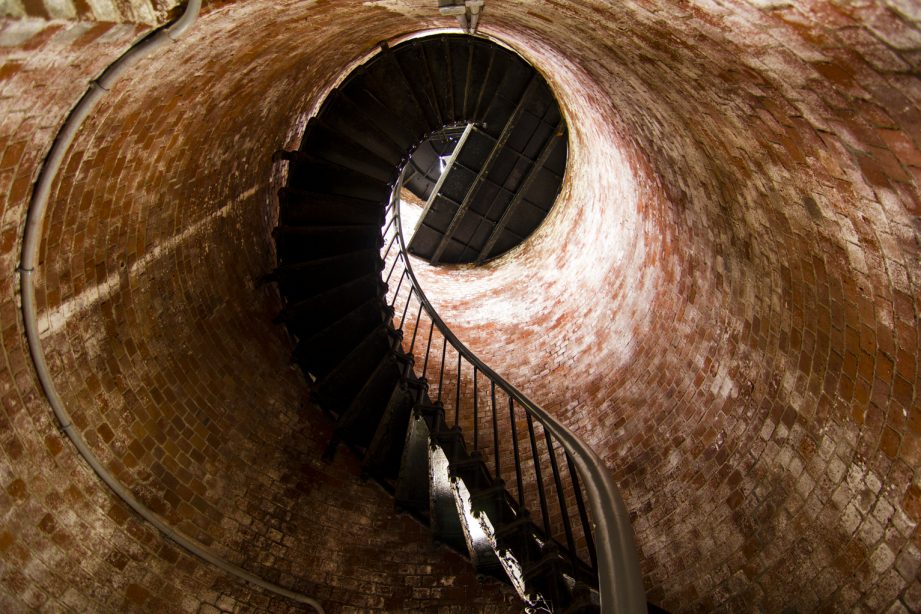
    Lighthouse Staircase
    The iron spiral staircase on the inside of the brick lighthouse on Great Duck Island.

    The Coast Guard automated the lighthouse in 1986, making the lighthouse keeper’s job unnecessary. The government then sold light stations across the country like the one on Great Duck to other government agencies or colleges and universities. In 1997, College of the Atlantic acquired the light station and residence to establish the Alice Eno Research Station. Today, College of the Atlantic owns a few acres on Great Duck Island while the Nature Conservancy owns almost all of the remainder.

    Herring gull and chick
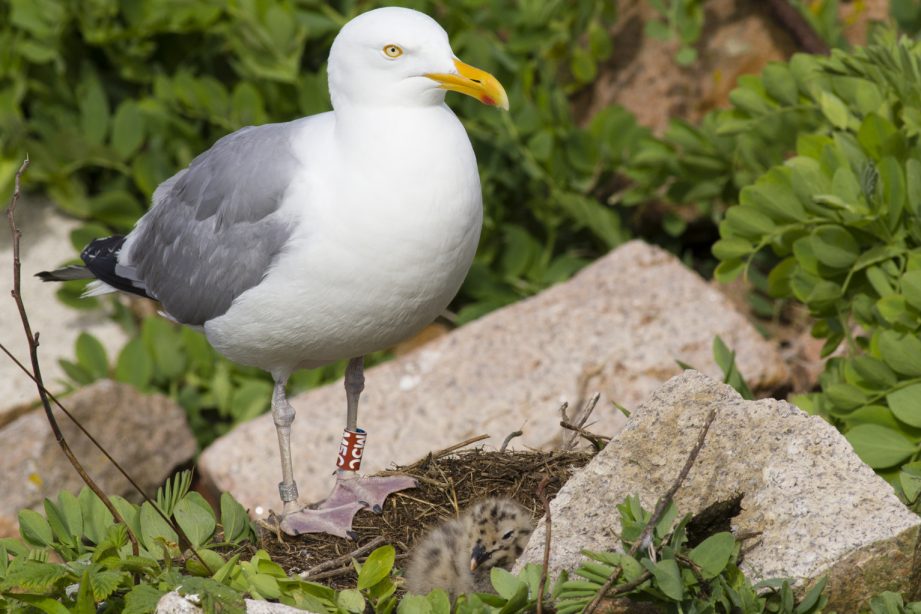
    A herring gull banded by College of the Atlantic and its chick.

    A Hotspot for Seabird Research

    For almost two decades, undergraduate and graduate researchers from College of the Atlantic have studied the island’s wildlife. Researchers prioritize monitoring the island’s breeding herring gull population and the growth of the gull chicks.

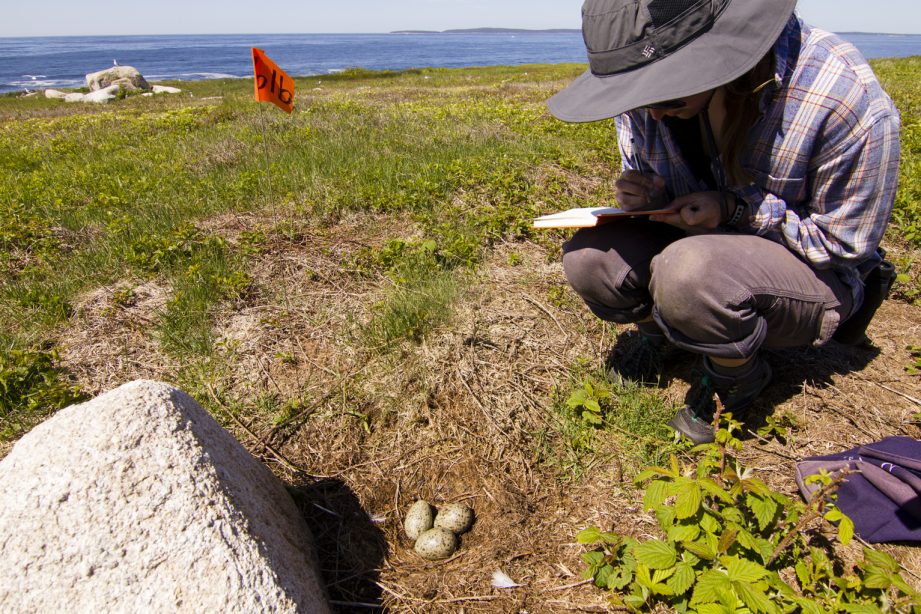
    Chick Check
    Recording the size and number of eggs in a herring gull nest for long-term monitoring over the summer as the eggs hatch and chicks emerge.

    The value of Great Duck Island as a research destination dates to Arthur Cleveland Bent. Bent was a naturalist who published Life Histories of North American Birds: Gulls and Terns in 1921. Bent takes much of his information on herring gulls from studies on Great Duck Island in the early 1900s. The nesting herring gull colony on the island is one of the largest on the eastern seaboard. The number of breeding gull pairs has declined from around 2,500 in Bent’s time to 1,300 today.

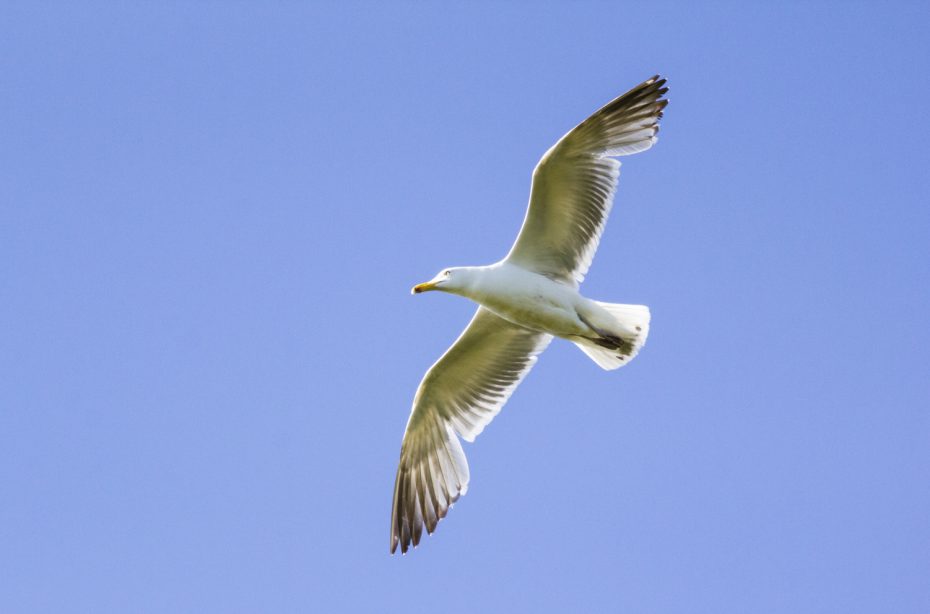
    Herring gull in flight
    The beautiful birds soar effortlessly around Great Duck Island.

    I’m fortunate enough to have the opportunity to help build on years of field research at Great Duck Island. This field season, I’m assisting with banding, measuring, and counting herring gulls. I’m also leading my own songbird survey of the island.

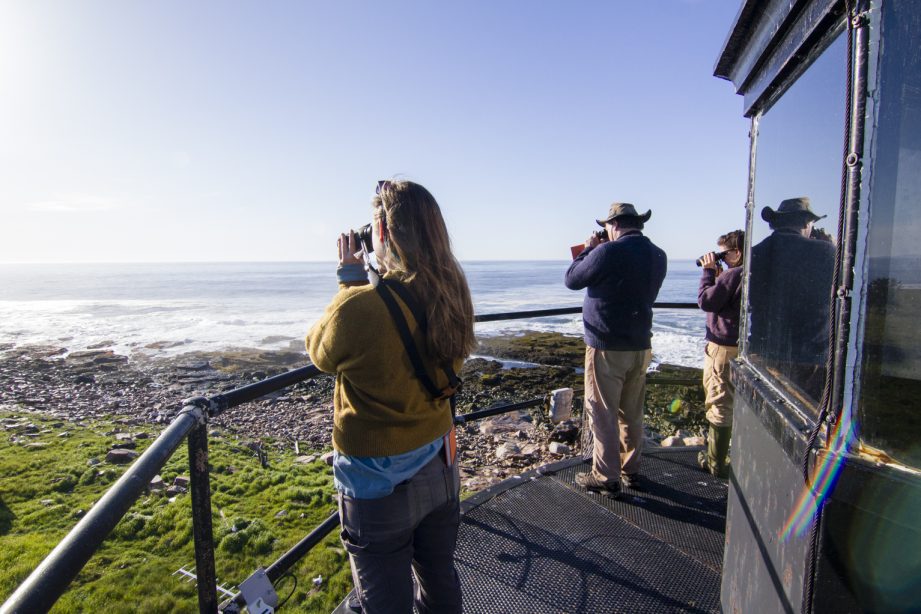
    Tower count
    Every morning College of the Atlantic researchers count every bird in sight from the top of the lighthouse tower.

    Tower Counts

    One tradition of the summer research season is to climb the lighthouse every morning at 7:00am and count all birds in sight—360 degrees around the tower platform. Everyday from the tower we see herring gulls, great black-backed gulls, black guillemots, and common eiders, all species nesting on the south end of the island.

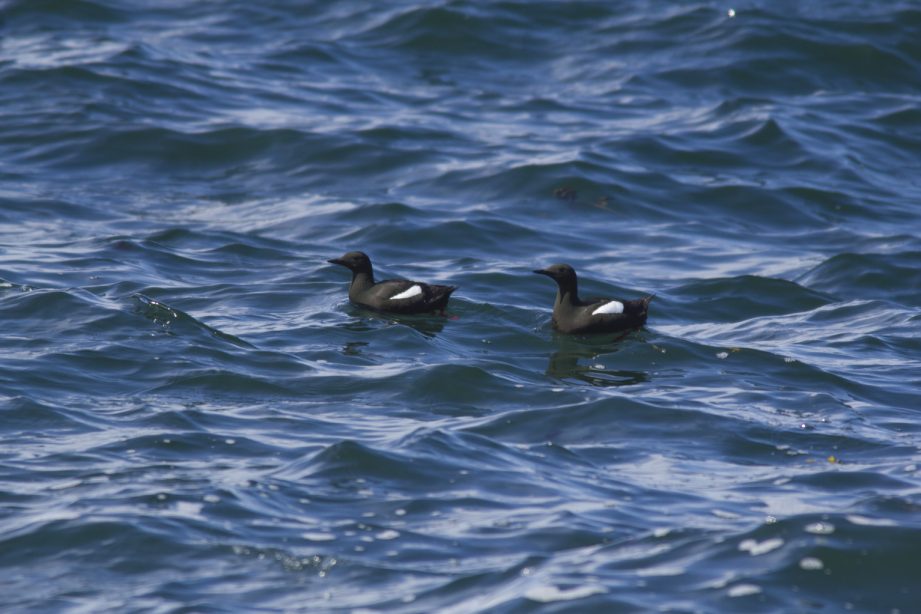
    Guillemots
    A pair of Black Guillemots swimming in the Gulf of Maine off the coast of Great Duck Island.

    Although they are at the southern extreme of their breeding range, Atlantic puffins appear frequently during counts. Puffins have even nested on the south end of the island in the past. Double-crested cormorants, razorbills, northern gannets, common terns, and common loons are other seabirds occasionally noted during tower counts.

    Eiders
    Common eiders are the largest seaduck and nest in small numbers on Great Duck Island.

    By the end of July, as many young birds fledge, so too will the College of the Atlantic field researchers. When another chaotic nesting season passes, Great Duck Island will have served its vital purpose to thousands of birds, many of whom will return next summer.